



UT Health San Antonio’s advanced endoscopy team leads efforts in early detection and prevention
Gastrointestinal cancers were previously believed to primarily affect older adults, but over the past two decades, rates of these cancers have increased dramatically in people under age 50. A new report from the Dana-Farber Cancer Institute reveals that colorectal, pancreatic, esophageal and other gastrointestinal cancer rates are rising sharply, with younger individuals seeing steeper increases and more advanced cancers.
Among gastrointestinal cancers, colorectal cancer is increasing the most in this younger population. In the past 20 years, colorectal cancer has risen from the fourth leading cause of cancer-related death in men under age 50 to number one, and it is the second leading cause of cancer death for women under 50, with breast cancer remaining number one, according to a study published in July in the British Journal of Surgery.
Taking the challenge head-on is Matheus C. Franco, MD, MBA, MSc, PhD, director of endoscopy at the UT Health San Antonio’s Multispecialty and Research Hospital, director of the third-space endoscopy program and associate clinical professor of gastroenterology at the Joe R. and Teresa Lozano Long School of Medicine.
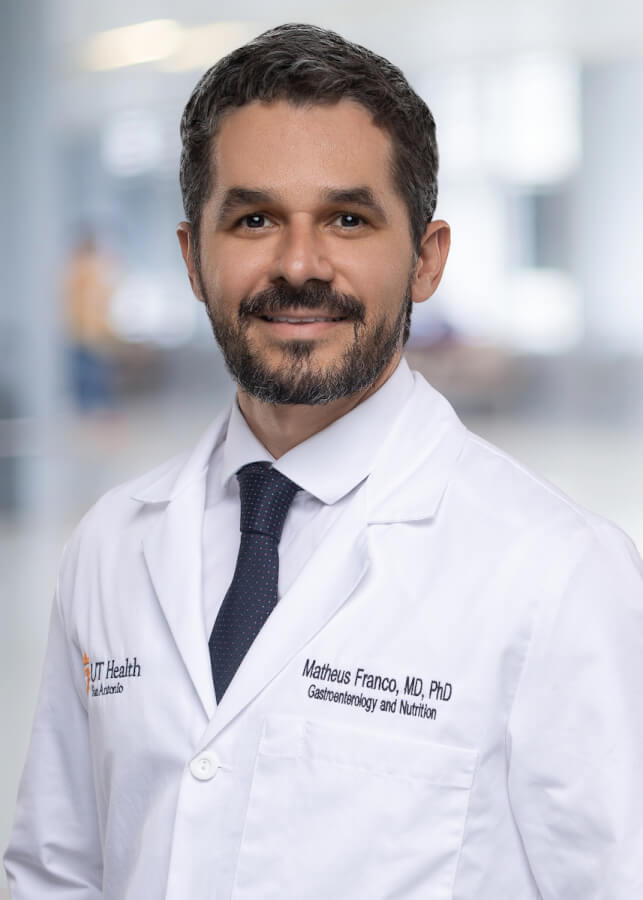
“This is something the younger population should be aware of and be aware that they have time to change it,” Franco said. “Colorectal cancer has highly effective screening and treatment options that can often prevent the disease before it develops.”
A shifting trend in cancer
The Dana-Farber report also said that between 2010 and 2019, the incidence of early-onset gastrointestinal cancers jumped nearly 15%, with the rise especially pronounced among women as well as Black, Hispanic and Indigenous populations.
While most early-onset cancers are related to genetic cancer risk mutations, much of the recent increase appears to be sporadic, or without a known cause. Rather than inherited risk, this expansion is believed to be driven primarily by lifestyle and environmental factors such as obesity, alcohol use, smoking, inactivity and diets high in red meat and processed foods.
Franco said the pattern mirrors what clinicians are seeing locally in South Texas, where more than half of adults are overweight or have obesity, which is a major risk factor for colorectal cancer.
“We can’t pinpoint one cause, but there have been major changes in diet, physical activity and weight over the last few decades,” Franco said.
Younger, more aggressive cases
A 2020 study published in Gastroenterology Research and Practice found that when gastric cancer arises in younger people, it may also present differently. While the overall rate of gastric cancer worldwide has greatly declined in recent decades, cases in younger people have increased. In this younger population, cancers are seen more often in women, have more aggressive tumor behavior and are diagnosed at a more advanced stage. However, younger people usually have fewer comorbidities, are better treatment candidates, and have better survival outcomes than older populations. The study noted that early-onset gastric cancer often goes undetected because screening guidelines rarely start before age 40, contributing to delayed diagnosis.
A recent review from Children’s Hospital Los Angeles indicates that metastatic stomach cancer in young adults is rising by about 2% each year. They noted that young people of Hispanic and Asian descent have more than three times the risk for metastatic stomach cancer. One differentiator they found was that younger adults with gastric cancer tend to have cancer lower in the stomach while older adults had cancer higher, near the esophagus. Scientists are also investigating a potential link to Helicobacter Pylori — common stomach bacteria connected to gastrointestinal cancers.
Seeing more, sooner with advanced endoscopy
The endoscopy team at the hospital uses state-of-the-art imaging and artificial intelligence to catch cancer earlier. While there are more diagnostic options than ever before, Franco said endoscopy and colonoscopy remain the gold standard for detecting these types of cancer because they allow direct visualization of the area and biopsy of suspicious tissue can be performed at the same time.
His team uses high-definition magnifying scopes that can zoom in up to 100 times and artificial intelligence-assisted visualization to automatically flag suspicious tissue during procedures.
“With AI, while the doctor is evaluating, the system also detects possible lesions and flags them on the screen,” Franco said. “That helps us catch abnormalities that might otherwise be missed and makes the procedure safer and more efficient.”
Propofol-based sedation allows for faster recovery, meaning most patients go home within an hour after the procedure.
Training and teamwork
As part of the region’s only advanced endoscopy fellowship, UT Health San Antonio trains the next generation of gastroenterology specialists in endoscopic ultrasound, endoscopic retrograde cholangiopancreatography and complex resection procedures for early cancers.
“With the new hospital, we were able to relaunch the program and expand to two advanced endoscopy positions [in the fellowship program],” Franco said. “It’s an important step for South Texas.”
Team-based collaboration is also key. At the hospital, gastroenterologists work closely with the Mays Cancer Center at UT Health San Antonio and surgeons, oncologists and radiologists work together to tailor treatment plans.
“At an academic health center, you truly work as a team,” Franco said. “We meet regularly to discuss complex cases and make the best plan for each patient.”
Research and the road ahead
Franco said pioneering research indicates that years from now, the future of gastrointestinal cancer diagnostics could be as simple as a blood test. Liquid biopsy is a technique where a small sample of blood can be used to detect cancer DNA fragments. The test is currently approved by the Food and Drug Administration for some advanced cancers, but Franco said he hopes it can someday be used to diagnose gastrointestinal cancers earlier, especially ones that are notoriously difficult to detect.
“In the future, it may be as simple as a blood draw in your 40s to detect early signs of pancreatic, biliary or colorectal cancer,” he said.
Heightened awareness of risk factors for gastrointestinal cancer, efforts for earlier evaluation and lifestyle interventions are more important than ever before for younger adults. Franco urges individuals to make lifestyle modifications if needed, such as increasing activity, losing weight, avoiding alcohol and smoking, increasing fiber intake and decreasing red meat, saturated fat and processed foods. He said to also be aware of colorectal red flags such as blood in the stool, abdominal pain, changes in size or shape of stool, unintended weight loss and anemia.
“Colorectal cancer appears to be highly influenced by environmental conditions. This can be good news for young people because they have time to make lifestyle modifications to prevent this type of cancer,” Franco said.
Don’t wait to start saving your life
Franco said all adults should begin colorectal screening at age 45, or earlier if there is a family history of cancer.
“The bottom line is — just do it,” he said. “Early screening saves lives, and our technology makes it more comfortable and precise than ever before.”